
The global shift from traditional soil-based farming to substrate-based container cultivation has revolutionized the blueberry industry. Growers are no longer asking if they should use containers, but rather: “How long do blueberry plants stay productive in containers?” While a blueberry bush in the wild can live for over 50 years, the commercial “productive lifespan” in a high-density container system is a different story. To achieve a high Return on Investment (ROI), you need to balance rapid early-stage growth with long-term root health.
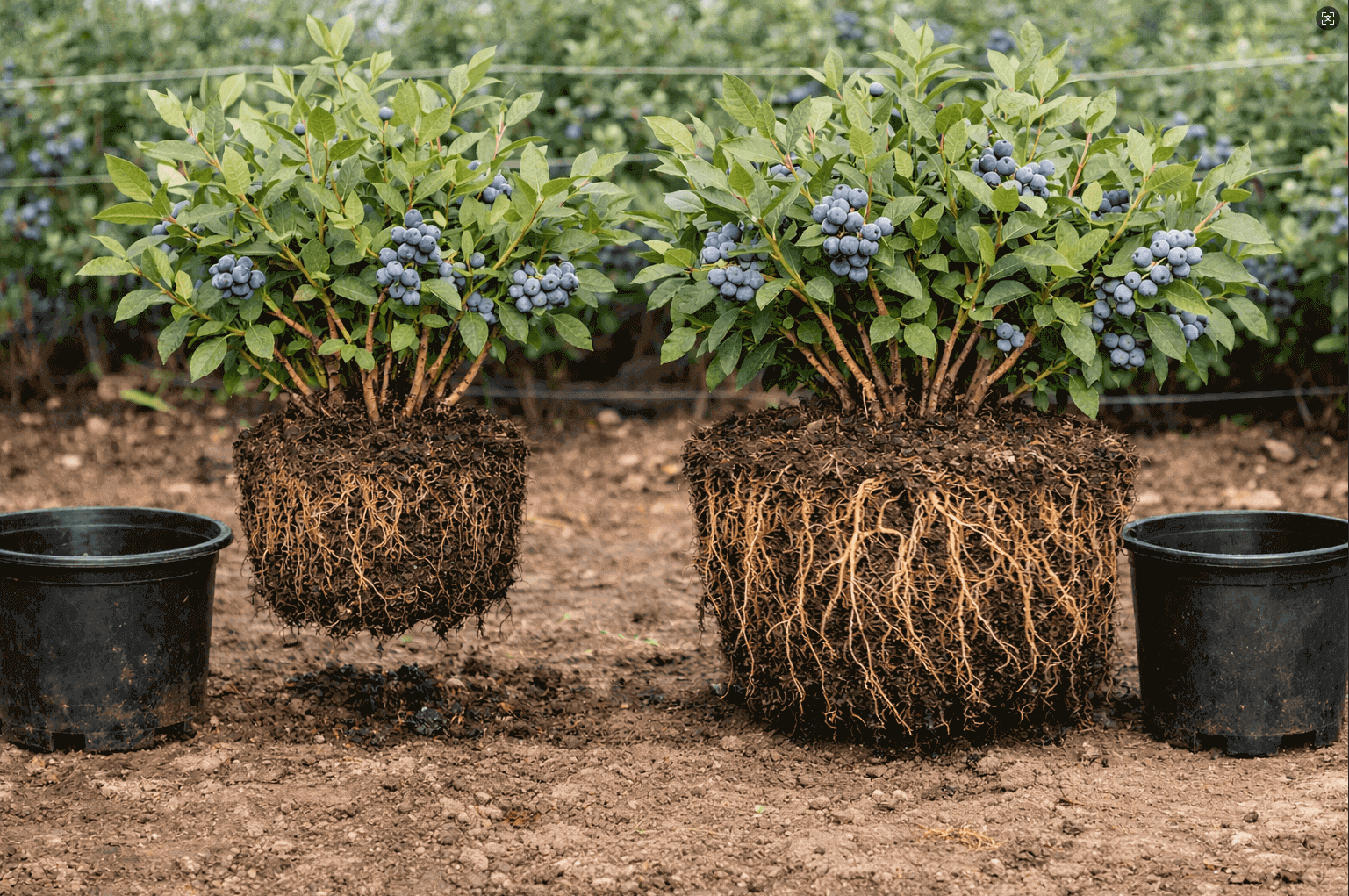
In this comprehensive guide, we will explore the factors that determine container longevity, the critical role of blueberry pot size (25L vs 35L), and how to maintain substrate pH management to ensure your orchard remains a “gold mine” for a decade or more.
1. The Lifespan Reality: Soil vs. Container Systems
In traditional soil planting, blueberries often take 6–7 years to reach full maturity and peak production. However, they are at the mercy of soil pathogens, inconsistent pH, and drainage issues.
In a NatureHydro substrate system, the timeline shifts:
- Accelerated Maturity: Plants can reach “mature” production levels as early as year 2 or 3.
- Commercial Peak: High productivity is typically maintained for 8 to 12 years.
- Rejuvenation Cycle: Unlike soil plants that may stay in one spot for 30 years, container plants are often “refreshed” or the substrate is replaced every 10 years to maintain the highest fruit size and quality standards required by modern retailers.
2. Critical Factor: Blueberry Pot Size 25L vs 35L
Choosing the right container volume is the single most important decision for long-term productivity.
25L Square Pots: The High-Density Specialist
The NatureHydro 25L Square Pot is the industry standard for Southern Highbush varieties.
- Best for: High-density planting (up to 3,500+ plants per hectare).
- Productivity Window: 7–9 years of peak performance.
- Pros: Lower initial substrate cost, easier to manage fertigation cycles, and perfect for varieties with a compact root architecture.
35L Grow Pots: The Long-Term Producer
For growers looking for maximum longevity and larger bush sizes, the 35L Grow Pot is superior.
- Best for: Vigorous varieties or regions with high solar radiation where root buffering is needed.
- Productivity Window: 10–12+ years.
- Pros: More “room to breathe” for the fibrous root system, reducing the risk of the plant becoming root-bound too early.
Expert Tip: If your goal is a quick 5-year “pick and flip” strategy, 25L is efficient. If you want a permanent orchard feel with 10+ years of stability, invest in 35L containers.
3. Substrate pH Management for Commercial Blueberries
Blueberries are “acid-loving” (acidophilic). In a container, you have 100% control over the root zone, but this also means errors are amplified.
- The Target Range: Aim for a pH of 4.5 to 5.2.
- The Buffer Challenge: Unlike soil, soilless substrates (peat moss, coco coir, perlite) have low buffering capacity. This means the pH can swing wildly based on your irrigation water.
- Long-Term Strategy: Use ammonium-based nitrogen sources to help maintain acidity. Regularly monitor the “EC/pH of the drainage” (leachate). If the drainage pH climbs above 5.5, your plants will stop absorbing iron, leading to chlorosis and a sharp drop in productivity.
4. Why Drainage Collection Pots for Blueberries are Non-Negotiable
The “number one killer” of potted blueberries is not pests—it’s root rot (Phytophthora) caused by standing water.
NatureHydro’s Long-Leg Design:
Our pots feature extended legs (up to 6.8cm). This creates a physical gap between the pot and the ground (or the drainage gutter).
- Air Pruning: When roots reach the drainage holes, the air stops them from circling, encouraging a dense, fibrous “root ball” inside the pot.
- Disease Prevention: By using drainage collection pots, you ensure that excess nutrient solution is carried away, preventing the spread of water-borne pathogens between plants.
5. Maximizing Longevity: The 3-Step Maintenance Routine
To keep your plants productive past the 8-year mark, follow this professional protocol:
- Step 1: Annual Pruning
Blueberries fruit on 1-to-4-year-old wood. By year 6, you must begin a “renewal pruning” program—removing old, grey “canes” to stimulate new, productive red-wood growth from the base.
- Step 2: Substrate Rejuvenation
Over time, organic substrates like peat can compress, losing their air-filled porosity (AFP). If you notice the substrate level has dropped by more than 20%, top-dress with fresh acidified coir or bark to protect the crown.
- Step 3: Managing the “Wet Zone”
The bottom 2–3 cm of any pot is the “saturated zone.” NatureHydro pots are engineered with a convex base and side-slotted drainage to minimize this zone, ensuring that even after 10 years, the bottom roots aren’t drowning in anaerobic sludge.
6. The Economic Verdict
While the initial cost of blueberries in containers (pots + substrate + fertigation) is higher than soil, the yield per hectare is often 200% to 300% higher in the first 5 years.
By selecting high-quality, UV-stabilized pots like the NatureHydro 35L series, you ensure the plastic doesn’t degrade before the plant does. Our injection-molded pots are designed to withstand 10+ years of intense sun and chemical exposure, matching the biological productive lifespan of the plant.
Ready to Upgrade Your Orchard?
Whether you are debating 25L vs 35L pots or need a complete drainage collection system, NatureHydro has the engineering expertise to support your farm’s longevity.
Explore our 2026 Catalog of Blueberry Solutions Here
Post time: Mar-09-2026